
Delivering a Retirement Platform
Leading multi-squad UX delivery across complex investment and pension journeys.
Context
Aegon Retirement Choices (ARC) is Aegon’s digital platform used by financial advisers to manage client investments and retirement products. The platform supports a range of financial products including Self-Invested Personal Pensions (SIPPs), Stocks & Shares ISAs and General Investment Accounts (GIAs), allowing advisers to manage client portfolios and retirement strategies through a single online solution.
The new ARC experience formed part of a multi-year transformation programme that replaced the legacy ARC platform with a modernised system built on a new technology stack. This transition created the opportunity to redesign the platform from the ground up rather than working within the constraints of the previous interface.
At the same time, Aegon introduced AXLE 1.0, the organisation’s first enterprise design system. This allowed the platform to be built using consistent design patterns and reusable components from the outset.
The transformation involved redesigning complex financial journeys such as pension drawdown, top-ups and investment management, while supporting multiple user roles including advisers, employers and customers.
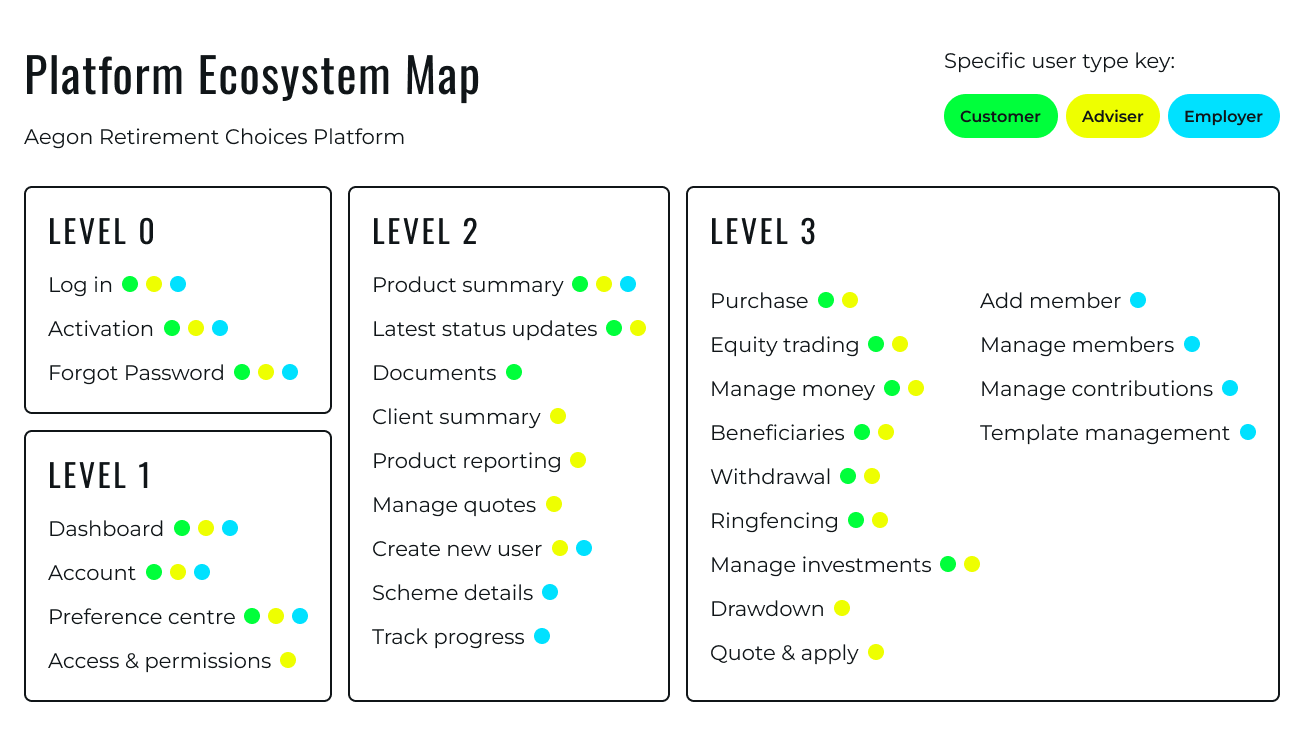
Platform complexity of ARC
Outcome
The programme delivered a modernised adviser platform built on a new technology stack, replacing the legacy ARC experience and establishing AXLE 1.0 as the foundation for scalable product development across the organisation.
The Challenge
The legacy ARC experience had evolved over time with inconsistent UI patterns and complex financial workflows that were difficult to navigate.
At the same time, multiple product squads were delivering new capabilities in parallel, increasing the risk of fragmented user experiences across the platform.
There were also challenges within the design practice itself. Designers were primarily using Axure, and the team had not previously worked with a shared design system or collaborative design tooling. This meant design workflows lacked consistency, and it was difficult for designers, developers and product teams to collaborate effectively.
The programme therefore required transformation across multiple dimensions:
redesigning complex financial journeys
introducing a design system
transitioning the design team to collaborative tooling
improving design governance and delivery practices across squads
My Role
My involvement in the programme evolved over time.
Initially, as a Senior UI Designer, I contributed to the development of AXLE 1.0, designing and documenting foundational UI components and interaction patterns for the new ARC platform.
During this phase I also supported the transition of the UX team from Axure to Figma, introducing collaborative design workflows that would enable the design system to be implemented effectively. I helped onboard designers to Figma and ran regular short “Figma Buzz Sessions” every two days, demonstrating how to use the tool, introducing newly created components and showing how they could be applied in product designs.
For many designers this was their first experience working with both Figma and a shared design system, so these sessions helped establish consistent design workflows across the team.
Partway through the programme I was promoted to Lead UX Designer, taking responsibility for UX delivery across the platform and leading five UX designers embedded within product sprint squads.
Approach
Establishing a Design System Foundation
Because the new ARC platform was being built on modern technology rather than legacy systems, we were able to introduce a shared design system from the outset.
I contributed to defining reusable UI components and interaction patterns within AXLE 1.0, enabling squads to build new product features using consistent design standards.
Transitioning the Team to Figma
Moving the design team from Axure to Figma was a key step in enabling collaborative workflows and supporting the adoption of the design system.
Through regular Figma Buzz sessions, I helped designers learn the tool, understand how to use shared components and adopt system-based design practices.
This helped establish a more scalable design workflow and increased confidence across the team.
Creating Structure Within Design Files
When I became Lead UX Designer, it became clear that design files lacked a consistent structure. This made it difficult for designers, developers and product teams to follow UX flows and understand the status of designs.
To address this, I introduced a standardised structure within Figma files to improve the clarity of UX flows and wireframes.
Before implementing the changes, I consulted content designers, product owners and developers to understand what information they needed from design files. This ensured the structure supported the needs of the wider product team, not just designers.
I also introduced accessibility documentation within design files to support clearer developer handover and ensure accessibility considerations were captured early in the design process.
Organising the ARC Figma Workspace
To further improve collaboration and clarity, I introduced a structured organisation for the ARC Figma workspace.
Projects and files were organised to clearly communicate the stage of design work:
Production
Source-of-truth designs representing what is currently live.
In Development
Designs that are fully documented and ready for engineering implementation.
Sandbox
Exploration space for designers to experiment with ideas.
Testing
Interactive prototypes used for validation and usability testing.
Archive
Previous or unused work retained for reference.
This structure helped reduce file complexity, improved visibility of design progress and made it easier for teams to navigate design work.
Introducing UX Quality Assurance
During delivery I identified a gap in the development workflow: design work was being implemented without a structured UX quality check before release.
To address this, I secured agreement for UX design review tickets in Jira, ensuring designers could validate work in the testing environment before it was pushed to production.
This introduced a simple but effective UX quality assurance step, helping maintain design integrity as new features were released.
Coordinating UX Across Multiple Squads
With designers embedded across several product squads, maintaining alignment across the platform was essential.
I introduced regular cross-squad design critiques and shared interaction standards, allowing teams to move quickly while maintaining consistency across the broader product experience.
Impact
The ARC programme delivered a modernised adviser platform built on a new technology foundation, replacing the previous ARC experience and enabling the organisation to scale new product capabilities more efficiently.
Key outcomes included:
introduction of AXLE 1.0 design system components across multiple product squads
successful transition of the UX team from Axure to Figma
improved collaboration between UX, Product and Engineering through clearer design workflows
structured UX quality assurance introduced into the development pipeline
a scalable platform foundation supporting complex pension and investment journeys across SIPP, ISA and GIA products
Reflection
Replacing a legacy platform while introducing a design system and new design tooling required balancing long-term design vision with the realities of continuous product delivery.
By aligning systems thinking, team workflows and delivery practices, we were able to modernise a complex financial platform while maintaining consistency and delivery momentum.
This experience reinforced how important design systems, collaborative tooling and clear governance are when scaling design across large product ecosystems.