
Scaling Design Capability in a Growing Organisation
Transforming a small UX design delivery function into a cohesive, strategic design organisation scaling from 6 to 15 designers in one year.
Context
When I stepped into this phase of the organisation’s growth, the UX Design team consisted of six designers supporting a rapidly expanding product portfolio. The business was scaling, delivery expectations were increasing, and product complexity was growing - but design capability had not yet evolved to match that pace.
Designers were embedded in project sprint teams, working hard and producing solid work, but there were gaps in shared standards, career progression, and cross-team alignment. As headcount plans accelerated, it became clear that scaling delivery alone wasn’t enough. We needed to scale design maturity, structure, and influence.
The Challenge
Growing from 6 to 15 UX designers within a year wasn’t just a hiring exercise. It presented several organisational challenges:
Maintaining quality while increasing delivery velocity
Preventing siloed ways of working across project teams
Defining clear role scopes and expectations
Building consistent standards across product areas
Ensuring design had a voice in roadmap and strategic decisions
Supporting the growth and development of less experienced designers
Without intentional structure, rapid growth can dilute culture and reduce impact. My role was to ensure the opposite happened.
My Role
I played a central role in shaping how design scaled within the organisation. This included:
Partnering with programme leadership and Talent to shape headcount planning and define role architecture to support sustainable team growth
Leading recruitment, designing the assessment process, hiring tasks, and interview framework
Defining capability expectations across levels while establishing rituals and governance to maintain quality at scale
Strengthening collaboration with Product and Engineering leadership
Mentoring and developing designers as the team expanded
My focus was not just increasing team size, but building a cohesive, high-performing design practice that could operate effectively at scale.
Key Decisions & Actions
I synthesised the challenges into four strategic focus areas, creating a clear framework to strengthen the team’s impact as we scaled.
1. Designing the Team Structure
As the team grew, we moved beyond informal coordination and introduced clearer structures:
Partnered with designers through 1:1s to identify development needs, set annual goals, and establish regular growth check-ins
Refined role boundaries to elevate senior designers into clearer leadership positions, fostering ownership, mentorship, and decision-making authority
Encouraged specialisation where needed while maintaining strong generalist foundations
This created clarity around ownership and progression.
2. Establishing Shared Standards & Rituals
To prevent fragmentation across squads, I introduced and strengthened:
Regular design critiques
Cross-team showcases
Shared design principles
Clear quality benchmarks
These rituals helped unify the team culturally and practically, raising the overall quality bar.
3. Investing in Growth & Mentorship
Scaling meant onboarding new designers quickly without compromising performance.
I prioritised:
Structured onboarding approaches
Mentorship and peer feedback between seniors and juniors
Clear development conversations
Creating space for designers to own problems, not just deliver outputs
This supported confidence, retention, and progression within the team.
4. Strengthening Design’s Strategic Influence
As the function matured, design moved from downstream execution to early-stage strategy. I enabled this shift by proactively partnering with senior leaders, positioning design as a trusted contributor to business decision-making.
I worked closely with the senior leaders to:
Clarify how and when design contributed to strategy
Advocate for discovery-led approaches
Align experience direction across product areas
Design shifted from reactive delivery to proactive strategic input.
Impact
Over a year, the UX team grew from 6 to 15 designers. More importantly, the design function evolved from a distributed delivery capability into a cohesive, strategically embedded practice.
Organisational Outcomes
3x increase in design capacity while maintaining quality benchmarks
Structured onboarding reduced time-to-productivity for new designers
Clear progression framework introduced across levels
Improved retention and internal mobility within the team
Operational Improvements
Increased consistency across product areas through shared standards and critiques
Reduced cross-squad duplication through clearer ownership and governance
Design embedded earlier in discovery and roadmap planning
Strategic Shift
Design transitioned from reactive execution to proactive strategic contribution
Stronger alignment with Product and Engineering leadership
Increased stakeholder confidence in design capability
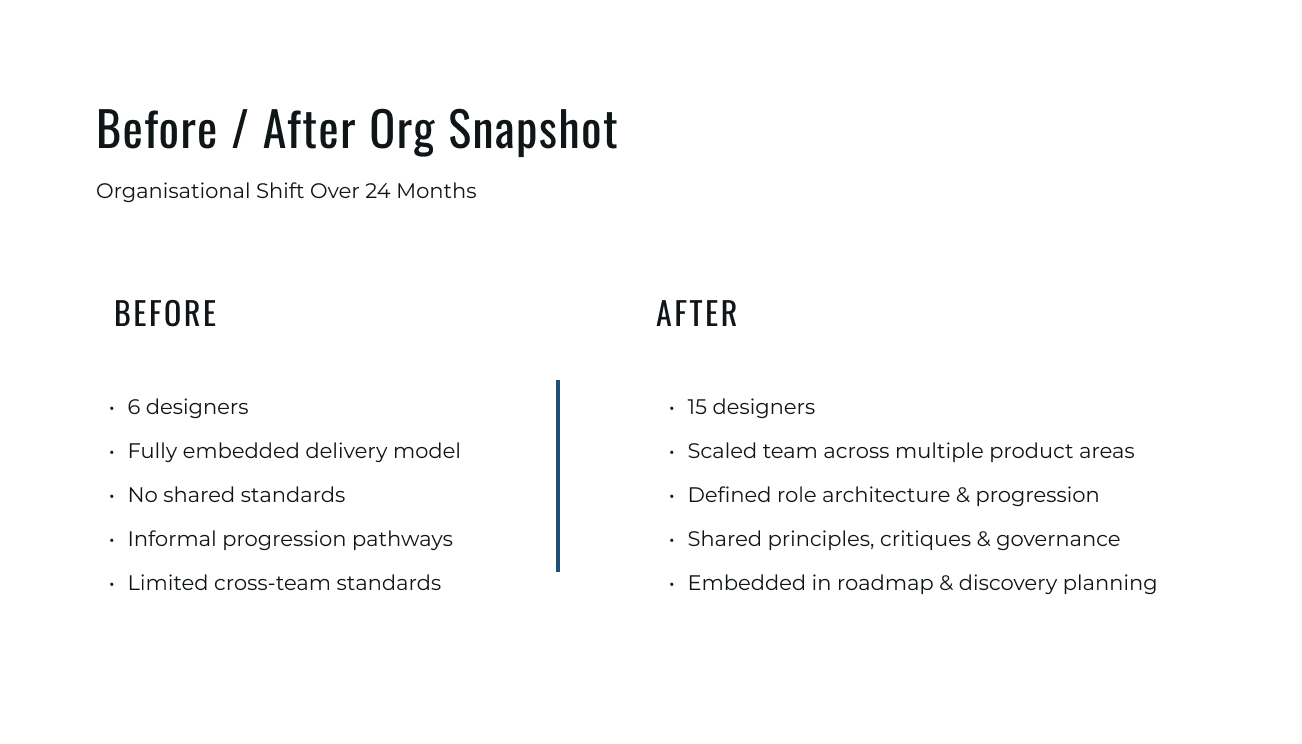
Snapshot of impact
Reflection
Scaling a design team is as much about culture and clarity as it is about headcount.
I learned that growth without structure creates noise - but growth with shared principles, strong mentorship, and intentional collaboration creates leverage.
By focusing on capability, standards, and influence (not just hiring) we were able to build a design practice that scaled sustainably alongside the business.